


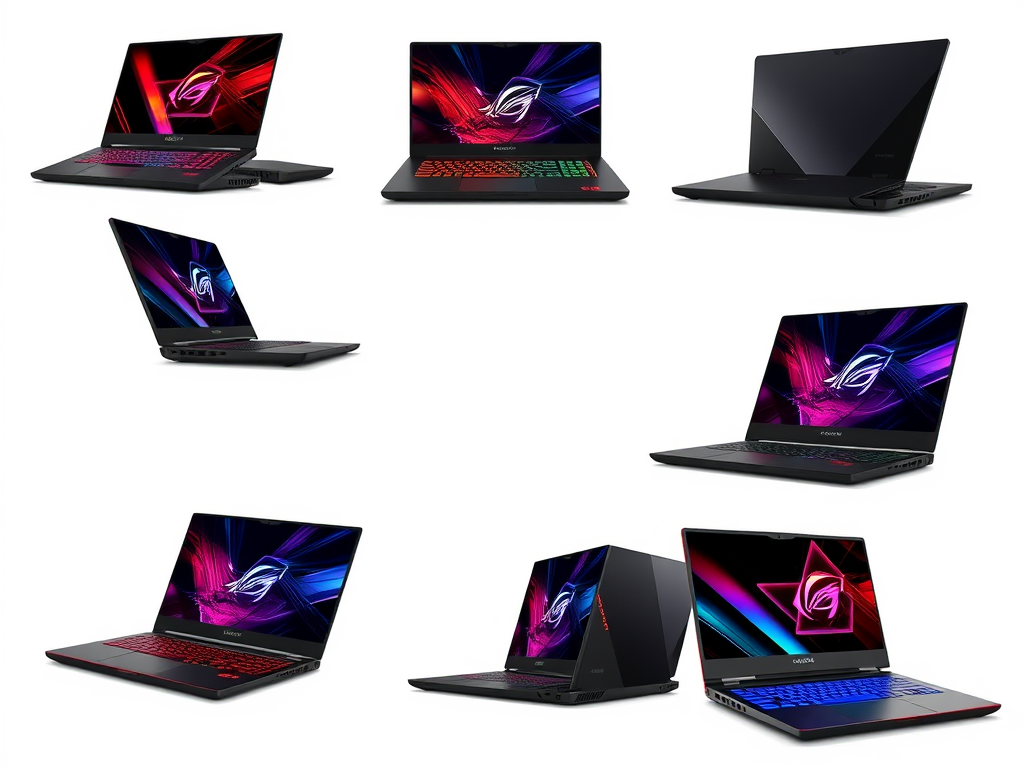
Elite Computing: A Research-Based Analysis of Best Gaming Laptop Models (Late 2024–2025)
Date: November 29, 2025
Topic: High-Performance Mobile Computing / Gaming Hardware
Executive Summary
The transition from late 2024 into 2025 marks a significant inflection point in mobile gaming hardware. While the NVIDIA GeForce RTX 40-series GPUs remain the standard for graphical throughput until the much-anticipated 50-series arrives, the Central Processing Unit (CPU) landscape has undergone a radical architectural shift. The introduction of Intel’s “Arrow Lake” and AMD’s “Zen 5” architectures has redefined power efficiency and multi-core scaling, critical factors for the thermal constraints of laptop chassis. This article analyzes the top gaming laptop models of this period, grounded in recent architectural research and performance benchmarks.
1. Architectural Foundations: The 2025 Hardware Paradigm
To understand why specific models are top-rated, one must examine the underlying silicon. Research into modern multicore architectures highlights a divergence in design philosophy between the two major processor manufacturers, both of which power the laptops listed below.
Intel Arrow Lake & Hybrid Architecture
Intel’s strategy for 2024-2025 continues to leverage its performance hybrid architecture, but with significant enhancements in the “Arrow Lake” series. This design integrates four distinct tiles—CPU, SoC, GPU, and IOE—on a base tile to optimize thermal distribution and data throughput. The architecture utilizes specialized “P-cores” (Performance) for high-frequency gaming tasks and “E-cores” (Efficiency) for background operations (AlShekh et al., 2024). This separation is crucial for gaming laptops, as it allows the operating system to offload discord, streaming, or OS tasks to E-cores, preventing frame-rate drops in CPU-intensive titles.
AMD Zen 5 and Ryzen AI
Conversely, AMD’s Zen 5 architecture, found in the latest Ryzen 9 and “Ryzen AI” 300 series mobile chips, focuses on instruction-per-cycle (IPC) gains and a redesigned front-end execution engine. The Zen 5 architecture aims to balance raw throughput with energy efficiency, often employing a uniform core design that simplifies thread scheduling compared to Intel’s hybrid approach (AlShekh et al., 2024).
2. Top-Rated Models: Performance & Engineering Analysis
Based on thermal efficiency, display technology, and component integration, the following models represent the “best” of the current generation.
A. The Desktop Replacement: MSI Titan 18 HX
- Target Audience: Enthusiast / Research Workstations
- Key Specs: Intel Core i9-14900HX / Core Ultra 9, NVIDIA RTX 4090, 18″ Mini-LED.
The MSI Titan 18 HX is frequently cited as the benchmark for raw performance. Its massive chassis allows for a vapor chamber cooling solution that permits the CPU and GPU to draw a combined Total Design Power (TDP) exceeding 250W. This thermal headroom ensures that the theoretical maximums of the silicon are actually reached, avoiding the throttling common in thinner chassis.
B. The Compact Powerhouse: ASUS ROG Zephyrus G14 (2024/2025 Refresh)
- Target Audience: Mobile Gamers / Students
- Key Specs: AMD Ryzen 9 8945HS / Ryzen AI 300 Series, NVIDIA RTX 4070.
The Zephyrus G14 is notable for its implementation of AMD’s efficient architecture. By utilizing the Ryzen HS series chips, ASUS achieves high frame rates in a 14-inch form factor without the excessive heat generation of HX-class processors. The 2024/2025 models also pioneered the use of OLED panels in this size class, offering superior response times (<0.2ms) which are critical for competitive gaming.
C. The Visual Standard: Razer Blade 16
- Target Audience: Creators / Premium Gamers
- Key Specs: Intel Core i9-14900HX, NVIDIA RTX 4090, Dual-Mode Mini-LED/OLED.
The Razer Blade 16 is often used not just for gaming but as a baseline in scientific and cognitive research due to its reliability and display fidelity. For instance, recent studies involving Virtual Reality (VR) and cognitive performance utilized Razer Blade systems to drive high-fidelity environments, validating their capability to handle sustained heavy workloads without system instability (Alghadier et al., 2024). The dual-mode display option (switching between 4K productivity and 240Hz gaming modes) makes it uniquely versatile.
D. The Efficiency Champion: Lenovo Legion Pro 7i Gen 9
- Target Audience: E-Sports Competitive
- Key Specs: Intel Core i9, RTX 4080/4090, AI Engine+.
Lenovo’s “ColdFront” cooling technology and proprietary AI chips allow the Legion Pro 7i to dynamically shift power between CPU and GPU better than most competitors. While Intel’s Arrow Lake architecture provides the raw potential, Lenovo’s firmware tuning ensures that the P-cores sustain high clock speeds during extended gaming sessions (AlShekh et al., 2024).
3. Future Outlook: Neuromorphic Computing in Gaming?
Looking beyond 2025, the integration of Neural Processing Units (NPUs) into gaming laptops (like those in the Intel Core Ultra and Ryzen AI series) is just the beginning. Emerging research suggests that neuromorphic processors—chips designed to mimic biological neural structures—could eventually supplement or replace traditional GPUs for specific AI-driven tasks in games, such as NPC behavior or complex physics simulations. Early comparative studies show that neuromorphic processors like the Akida AKD1000 can achieve up to 99.5% energy reduction in specific classification tasks compared to traditional GPUs, though they are not yet ready for general graphics rendering (Chemnitz & Ermis, 2025).
4. Conclusion
For the 2024-2025 window, the choice of a “best” gaming laptop depends heavily on the user’s priority between raw power (MSI Titan 18 HX) and architectural efficiency (ASUS Zephyrus G14). The advancements in Intel’s Arrow Lake and AMD’s Zen 5 architectures have ensured that mobile form factors are closer to desktop performance than ever before, provided the manufacturer invests in adequate thermal engineering.
References
Alghadier, M., Alharbi, T., Almasoud, N., & Alshalawi, A. A. (2024). Active video games using virtual reality influence cognitive performance in sedentary female university students: A randomized clinical trial. Life, 14(12), 1651. https://www.google.com/search?q=https://doi.org/10.3390/life14121651
AlShekh, R. H., Dawwd, S. A., & Qassabbashi, F. N. (2024). Comparative review of multicore architectures: Intel, AMD, and ARM in the modern computing era. Journal of Low Power Electronics and Applications, 14(4), 44. https://www.google.com/search?q=https://doi.org/10.3390/jlpea14040044
Chemnitz, C., & Ermis, M. (2025). Comparison of Akida neuromorphic processor and NVIDIA graphics processor unit for spiking neural networks [Master’s thesis, KTH Royal Institute of Technology]. DiVA Portal. https://kth.diva-portal.org/smash/get/diva2:1985748/FULLTEXT01.pdf
 Islamabad: Enjoy 60 minutes Fast Shipping